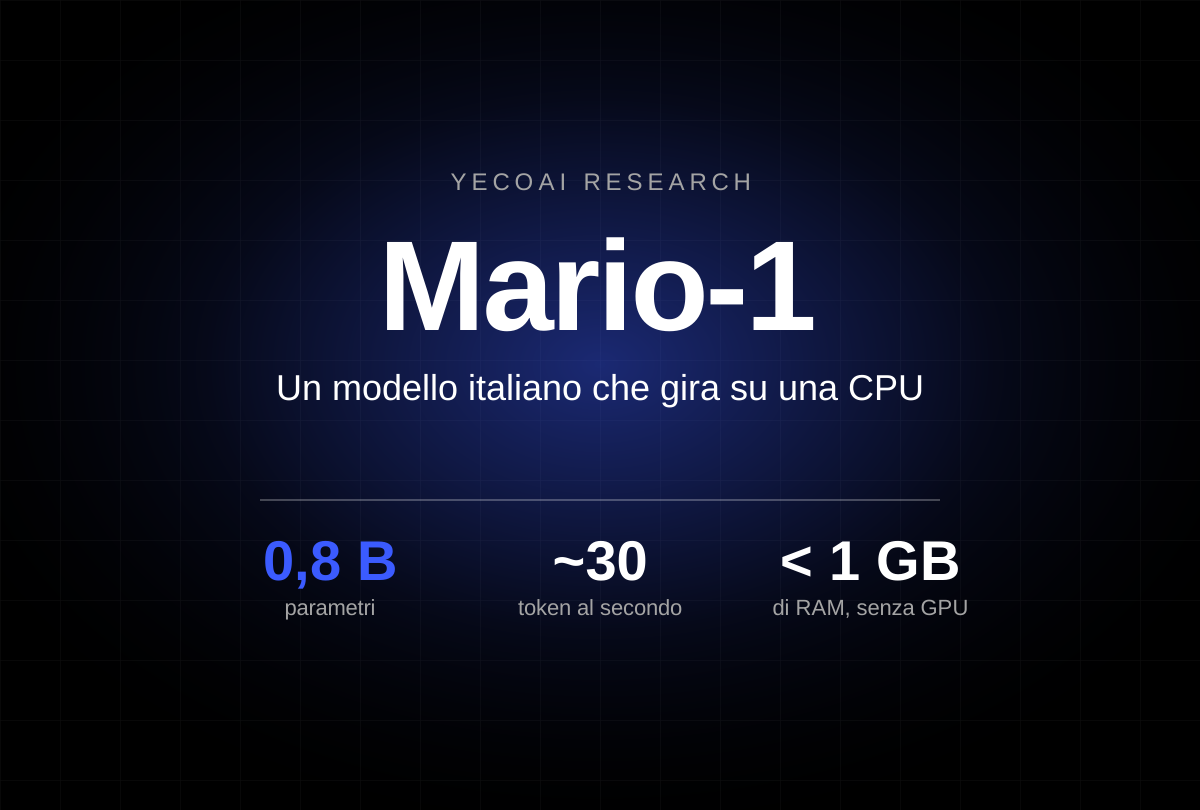
Mario-1: an Italian language model that runs on a CPU
A 0.8-billion-parameter language model built for Italian. It runs on a CPU without a GPU, recognises trick questions, admits what it does not know and does reliable arithmetic.
Research

The first version of our model for finding personal data. It beat larger competitor models on six European languages.

We present Yeco-PII v1.0, a 278M-parameter neural model for PII detection and anonymization that outscores both Rizzo-PII (0.3B) and the OpenAI Privacy Filter (1.5B), a model 5.4× its size, on every one of the six European languages tested: average F1 0.966 against 0.726 and 0.776 under the historical v1.0 protocol (17-tag gold), with per-language scores from 0.92 (Dutch) to 0.99 (French). The model detects 24 entity types, including names, tax IDs, and addresses that carry no checksum to validate, by reading context rather than applying formulas, with native Italian coverage (codice fiscale, partita IVA, cadastral data) and an anonymization-policy engine that turns detection into production-ready redaction. This article documents the motivation, the benchmark methodology, the error analysis, and the deployment story.
Classical PII tooling leans on format validation: an IBAN survives mod-97, a credit card survives Luhn. That works for the entities math can check and fails for the entities that dominate real documents. Names, street addresses, organizations, and dates have no checksum; a validator either matches a finite dictionary (missing everything new) or accepts a regex shape (accepting junk). On the Ai4Privacy benchmark rows, the gap concentrates exactly there: legacy and general-purpose models lose 20-30 F1 points on person names and addresses, while remaining adequate on the formula-checkable few.
The second failure is semantic. A date is not a date: a date of birth must be redacted; a regulation's entry-into-force date must survive. A name is not a name: the issuing authority in a certificate is an organization, not a person. Context-free tools cannot make these calls, so they over-redact (destroying document usefulness) or under-redact (leaking the very data the exercise exists to protect). Yeco-PII's thesis is that this is a language-understanding problem, and should be solved by a language model sized for the job, not a bigger generalist.
Yeco-PII v1.0 is a 278M-parameter encoder trained for token-level entity recognition across 24 protected types: person names, organizations, tax IDs and codice fiscale, VAT numbers, IBAN, credit cards, emails, phone numbers, birth dates, addresses, ZIP codes, provinces, amounts, document references, license plates, and more, with paired tags distinguishing semantically different occurrences (birth date vs reference date). The model ships in standard HuggingFace format (~1.1 GB), runs at ~3,700 characters/second on CPU (~1 GB RAM at scale), and integrates as a plain pipeline step. Censorship policies, masking, pseudonymization, or format-preserving substitution, are defined in JSON or natural language and apply instantly, with no retraining.
Evaluation uses a mix of real and synthetic data inspired by real-world scenarios, never seen in training, annotated by a third party (Ai4Privacy), with the identical test set for every model compared. Historical v1.0 protocol: 17-tag gold (no IP, USERNAME, TIME or COUNTRY), measured in September on held-out Ai4Privacy documents, themselves a mix of real and synthetic data inspired by real-world scenarios. The headline: average F1 0.966 for Yeco-PII v1.0 (multilingual, 6 languages), against 0.776 for the OpenAI Privacy Filter (1.5B, type-agnostic scoring) and 0.726 for Rizzo-PII (0.3B, tolerant scoring), with wins on all six languages: Italian, English, French, German, Spanish, Dutch. On 600 Italian rows, same protocol, F1 is ~0.966, with tax codes, VAT numbers, IBANs, emails, phone numbers, names and addresses between 0.94 and 0.99.

| Language | Yeco-PII v1.0 (278M) | Rizzo-PII (0.3B) | OpenAI Privacy Filter (1.5B) |
|---|---|---|---|
| 6-language average | 0.97 | 0.73 | 0.78 |
Under today’s protocol (gold extended to 30 tags, including IP, USERNAME, TIME, COUNTRY and GEOCOORD), measured on October 17, 2026 on 600 Italian rows, Yeco-PII v1.0 scores P 0.970, R 0.734, F1 0.835, against P 0.984, R 0.969, F1 0.977 for Yeco-PII 2.0. The drop from 0.966 to 0.835 is not a regression: the gold now includes categories v1.0 was never trained to detect (TIME, IP and USERNAME at F1 0.000, about 830 missing entities over 600 rows). On the adversarial suite, v1.0 scores F1 0.912 (P 0.984, R 0.849), against 0.950 for 2.0.
Honest reporting includes the misses. The residual errors concentrate in three areas: heavily abbreviated or malformed entities (a surname split across formatting artifacts), rare foreign names outside European patterns, and boundary cases where document layout (tables, signatures) scatters a single logical entity. Each is a data problem more than an architecture problem, and each is tracked in the evaluation harness; the model card for licensed clients includes the per-category breakdown.
Detection alone does not ship. The policy engine turns spans into actions: mask with type tags, replace with realistic surrogates that preserve format (an anonymized codice fiscale is still 16 characters and still passes format checks), or substitute per-customer mappings that stay consistent across documents in a corpus. Policies defined in natural language compile to the same internal representation as JSON ones, the compliance team writes "keep invoice totals and VAT numbers, redact everything about the customer", and the engine implements it verifiably. The model is used in the product DeskNexo to anonymize tickets before they reach third-party models.
Enterprise access starts with an API trial on the customer's own documents; licensing is a one-time payment with on-premises delivery in HuggingFace format, the model runs entirely within the client's perimeter, with no per-request fees and no data egress. Public APIs for individual developers and smaller teams are rolling out progressively. Inside YecoAI, Yeco-PII is the privacy layer of DeskNexo: ticket data is anonymized before any third-party model processes it.
Yeco-PII v1.0 shows that the PII problem rewards understanding over scale: a 278M model that reads context beats a 1.5B generalist on every language tested, runs on CPU, and costs a fraction to operate. For organizations with a compliance obligation, hosting, healthcare, banking, the result is practical: GDPR-grade anonymization that fits on a VM, licensed once, running where the data already lives. The benchmark harness, the model card, and the integration documentation are available to evaluation partners on request.
Context beats checksums: 0.966 average F1 across six languages (historical v1.0 protocol) with 278M parameters, native Italian. Privacy is a language problem, and language problems have small, honest answers.
A 0.8-billion-parameter language model built for Italian. It runs on a CPU without a GPU, recognises trick questions, admits what it does not know and does reliable arithmetic.
Our new model that finds and hides personal data in text. More accurate than the previous version and better than much larger models, especially in Italian. Every release is digitally signed, so you can verify it is genuine.

118.1M-parameter Italian micro-LLM, trained for under €15, ~200 tok/s on CPU. Beats Minerva-350M (3× its size) on BoolQ-IT.