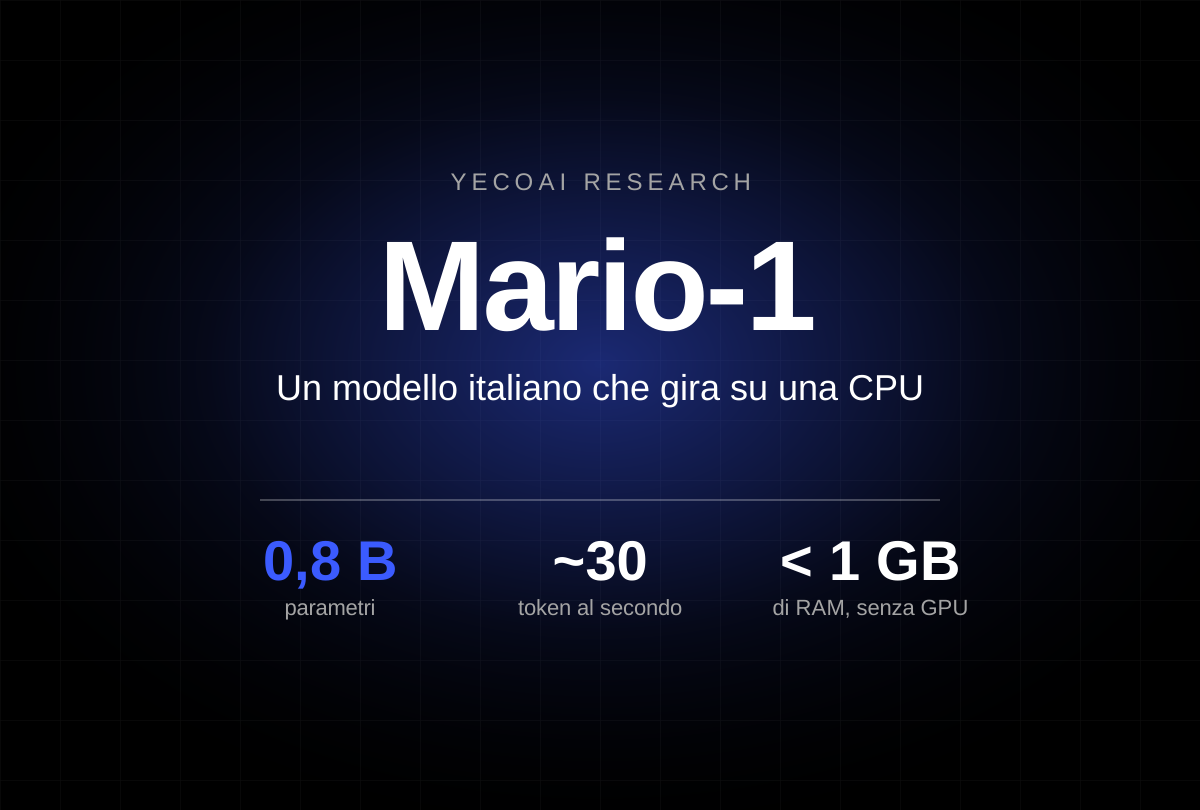
Mario-1: an Italian language model that runs on a CPU
A 0.8-billion-parameter language model built for Italian. It runs on a CPU without a GPU, recognises trick questions, admits what it does not know and does reliable arithmetic.
Research

118.1M-parameter Italian micro-LLM, trained for under €15, ~200 tok/s on CPU. Beats Minerva-350M (3× its size) on BoolQ-IT.
We present Yeco Flash Mini-IT v1, a 118.1M-parameter decoder-only language model for Italian that proves a contested point: sovereign, useful language models no longer require frontier budgets. Trained end to end for less than €15 of H100 time, Flash Mini-IT implements a custom 32k BPE tokenizer engineered for Italian morphology and post-SFT behavior that eliminates the failure modes typical of micro-scale models. On the official ITA-Bench suite (SapienzaNLP), it answers BoolQ-IT at 62.5%, above Minerva-350M (60.7%), a model 3× its size with roughly 70B pretraining tokens behind it. The model, its tokenizer, and its full training pipeline are released under Apache 2.0 with a complete model card, including the limitations.
Italian occupies an awkward position in the open-model landscape. The largest multilingual checkpoints treat it as one tail among a hundred; the few Italian-specialized models (MINERVA, Fauno, Camoscio) sit at 350M-7B parameters with limited documentation of their training economics. Meanwhile, the cost of a single frontier pretraining run exceeds the entire annual budget of most Italian research groups. The result is a gap: no reproducible, fully documented pipeline showing what a minimal Italian LLM costs and how far it gets.
Flash Mini-IT was designed as exactly that reference point. Every design decision, tokenizer, architecture, data mixture, training schedule, was made to maximize Italian-language quality per euro of compute, and every number in this article is measured on public benchmarks rather than estimated. Where the model loses, we say so: the model card reports full per-task results including the tasks where Minerva-350M clearly wins.
The backbone is a GPT-2-style decoder-only transformer: 12 layers, hidden dimension 768, 12 attention heads, pre-LN normalization, and weight tying between input embeddings and the output projection. On top of the standard attention computation we add a learned context gate, a sigmoid-modulated scaling of attention scores, which stabilizes training at this scale and improved early validation loss in ablation runs.
The tokenizer is where most of the Italian-specific engineering lives. A byte-pair encoding vocabulary of 32,000 tokens was trained from scratch on Italian Wikipedia, replacing GPT-2's byte-level BPE whose merges were optimized for English. The resulting tokenizer has a fertility of 1.53 tokens per word, a 34% reduction against GPT-2 on the same Italian corpus. Fewer tokens per word means longer effective context, less attention computation, and faster generation, a compounding advantage that shows up in every downstream metric per unit of compute.
Training proceeded in two phases, both on a single NVIDIA H100 rented on Modal.
Evaluation: measured, not estimated
All benchmark numbers come from the official ITA-Bench datasets (sapienzanlp/arc_italian, hellaswag_italian, boolq_italian, truthful_qa_italian, gsm8k_italian), evaluated with the official ITA-Bench harness for LLM evaluation on Italian tasks: accuracy in percent, zero-shot protocol, 4k context window, results averaged over 3 runs. Emma-5 550M numbers come from the same setup; Minerva-350M figures are from its paper (see the note below the table). These are measured numbers, not projections.
Reading the numbers honestly: Flash Mini-IT takes BoolQ (62.5%, the model’s best score of the suite, ahead of Minerva-350M’s 60.7% despite Minerva’s 3× size and ~70B pretraining tokens), while Minerva-350M stays ahead on ARC-Challenge (24.6% vs 23.0%), HellaSwag, TruthfulQA and GSM8K, and on the five-task average (42.5% vs 36.1%). The chat version (SFT v3) also stays at a 36.1% average. The value of SFT shows in behavior rather than in these scores: a reliable question → answer → stop format, elimination of question echo, and structured chat answers.

| Task | Yeco Flash Mini-IT 118M | Emma-5 550M | Minerva-350M |
|---|---|---|---|
| ARC-Challenge | 23.0 | 22.0 | 24.6 |
| HellaSwag | 26.0 | 31.5 | 32.6 |
| BoolQ | 62.5 | 39.0 | 60.7 |
| TruthfulQA | 34.5 | 21.0 | 46.5 |
| GSM8K | 34.5 | 39.0 | 48.2 |
| Five-task average | 36.1 | 30.5 | 42.5 |
Minerva-350M figures are from its paper (full N, possibly different few-shot): same benchmark and scoring, different N. The Minerva paper may also use a different evaluation protocol (number of few-shot examples, prompt format, score normalization), so part of the gap may come from the protocol rather than from the models. Baseline comparisons are therefore indicative, not certified head-to-head runs: only a run of Minerva-350M under our exact protocol would settle the comparison. On generative behavior, the post-SFT model reliably produces input → response → stop, has lost the echo failure ("What is Windows → windows ["), and produces sensible lists and prose on general-knowledge questions. Weaknesses are documented rather than hidden: self-identity is inconsistent, factual recall at 118M parameters / 1.25B tokens invents specifics, and the model imitates the form of chain-of-thought reasoning while failing the arithmetic.
The SFT prompt format is a two-line template, [CHAT] Utente: {question} / Assistente:, with generation stopped on a fixed four-token id sequence ([END]). The final checkpoint (models/best_v2.pt), the tokenizer (models/it_bpe_32k.json), the full Modal training pipeline (train_v2.py), the data preparation scripts (scripts/prepare_v2_datasets.py), and the benchmark harness (run_real_itabench.py) ship together under Apache 2.0. A chat GUI (chat_gui.py) is included for interactive evaluation. One sharp edge is documented for reproducers: the special chat tokens are not in the vocabulary file, do not add them with add_special_tokens, as ids ≥ 32768 will crash the model.
The model card identifies three levers, in order of expected impact: continued pretraining on 2-3B further tokens (Wikipedia + packed QA, estimated $4-6), the only lever that moves ARC/HellaSwag/TruthfulQA; more aggressive self-identity data plus light DPO; and a full lm-evaluation-harness run on complete datasets for certified numbers. Flash Mini-IT is intentionally a living checkpoint: every result above will be superseded as the series trains, and the model card is versioned to make each step auditable. The model is part of the Yeco LLM Series, which brings together all YecoAI models.
A fully documented Italian LLM, tokenizer to benchmark, for the price of two pizzas. That is the reproducible floor the sovereign-AI debate was missing.
A 0.8-billion-parameter language model built for Italian. It runs on a CPU without a GPU, recognises trick questions, admits what it does not know and does reliable arithmetic.
Our new model that finds and hides personal data in text. More accurate than the previous version and better than much larger models, especially in Italian. Every release is digitally signed, so you can verify it is genuine.
Our AI model for EnderDevelopment, a fine-tune of Qwen2.5-Coder-1.5B (Apache 2.0). It is used only inside the product and is not publicly available.