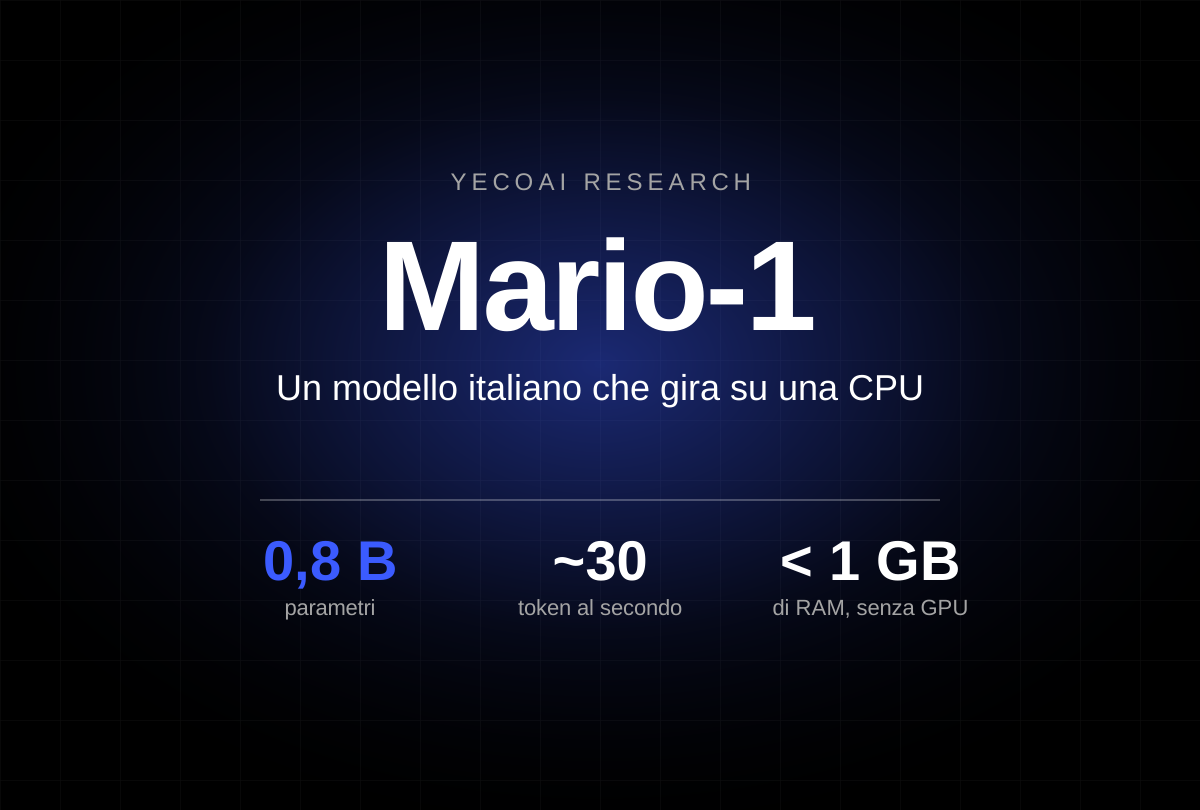
Mario-1: an Italian language model that runs on a CPU
A 0.8-billion-parameter language model built for Italian. It runs on a CPU without a GPU, recognises trick questions, admits what it does not know and does reliable arithmetic.
Research

Our AI model for EnderDevelopment, a fine-tune of Qwen2.5-Coder-1.5B (Apache 2.0). It is used only inside the product and is not publicly available.
Correction note: an earlier version of this page described Ender-1 as a fine-tune of Qwen2.5-Coder-3B. After clarifying the license, the 3B model turns out to be distributed under a non-commercial license: Ender-1 is therefore based on the 1.5B model (Apache 2.0). Details in the full correction.
Ender-1 is the proprietary code model behind EnderDevelopment: a heavily optimized fine-tune of Qwen2.5-Coder-1.5B, trained on EnderDevelopment's own usage data. It is not a general-purpose model and not part of the Yeco LLM Series, which remains fully proprietary: Ender-1 inherits Qwen's Apache 2.0 base and specializes it for one job, turning gaming community intents into working Minecraft plugins, FiveM scripts, Discord bots, and valid server configs. It will never be released as open weights or via public API: Ender-1 ships exclusively inside EnderDevelopment, and this article documents what it is, how it was built, and its rollout plan.
Ender-1 starts from Qwen2.5-Coder-1.5B, a small code model released under Apache 2.0, and adapts it with a two-stage recipe: continued pretraining on EnderDevelopment's code-and-config distribution (Spigot/Paper Java/Kotlin plugins, plugin.yml, permission trees, BungeeCord/Velocity YAML/JSON, FiveM Lua, Discord bot sources), followed by instruction tuning on intent-to-artifact pairs from the platform's real traffic. The result is deliberately narrow: where the base model is a general code assistant, Ender-1 is a specialist in the exact stacks and request shapes EnderDevelopment serves.
The distinction matters. The Yeco LLM Series models (Yeco-PII, Flash Mini-IT) are trained from scratch or on our own pipelines and are fully proprietary. Ender-1 is a different category: a fine-tune of an excellent open base, optimized and evaluated so tightly that it beats larger generalists on its home turf. Vertical data and tight evaluation beat raw scale in a narrow domain, the same principle behind Yeco-PII outscoring models 5.4 times larger on PII detection.
The fine-tuning corpus comes exclusively from EnderDevelopment's free tier, under the platform's standing policy: de-identified prompts and accepted generations, no account identifiers or payment data, filtered third-party copyrighted assets, account-level opt-out honored in every training snapshot. The prompts already processed by the platform are the seed; the compounding loop (more users, more intents, better model, better generations) is the actual asset.
Ender-1 will not be released as open weights, will not be served through a public API, and will not be licensed: it runs only inside EnderDevelopment. The reasons are practical, not ideological. The model's value is inseparable from the platform's verification pipeline (compile checks, config validation, functional tests), so serving it standalone would strip away exactly what makes its outputs reliable. Releasing it would also hand competitors the distillation of our most valuable dataset. EnderDevelopment has always used European models for its pipeline, Codestral Latest among them, and Ender-1 is the step where the platform's own proprietary model takes over that role.
Ender-1 rolls out to EnderDevelopment users in stages, with the previous pipeline kept as fallback at every step and as permanent verifier for what Ender-1 produces. Ender-1 is available only inside EnderDevelopment. The structure:
Every Ender-1 output is compiled, packaged, and functionally checked before reaching a user, the same dual-LLM discipline that guards DeskNexo: Ender-1 proposes, the production pipeline verifies. Regressions surface within hours because the evaluation set is the platform's own traffic.
The agenda follows the rollout: publish aggregate quality metrics from each stage (generation success, functional pass rates by category), iterate checkpoints on a fixed cadence as the corpus grows, and decide on schedule whether Ender-1 replaces the previous pipeline outright. Ender-1 is the first YecoAI model born from a live product, and the template for how our data engine works: real usage, governed by policy, compounding quality.
Distribution first, data from real intents, evaluation by compilation. Ender-1 is what a product-trained fine-tune looks like when the loop closes.
A 0.8-billion-parameter language model built for Italian. It runs on a CPU without a GPU, recognises trick questions, admits what it does not know and does reliable arithmetic.
Our new model that finds and hides personal data in text. More accurate than the previous version and better than much larger models, especially in Italian. Every release is digitally signed, so you can verify it is genuine.

118.1M-parameter Italian micro-LLM, trained for under €15, ~200 tok/s on CPU. Beats Minerva-350M (3× its size) on BoolQ-IT.