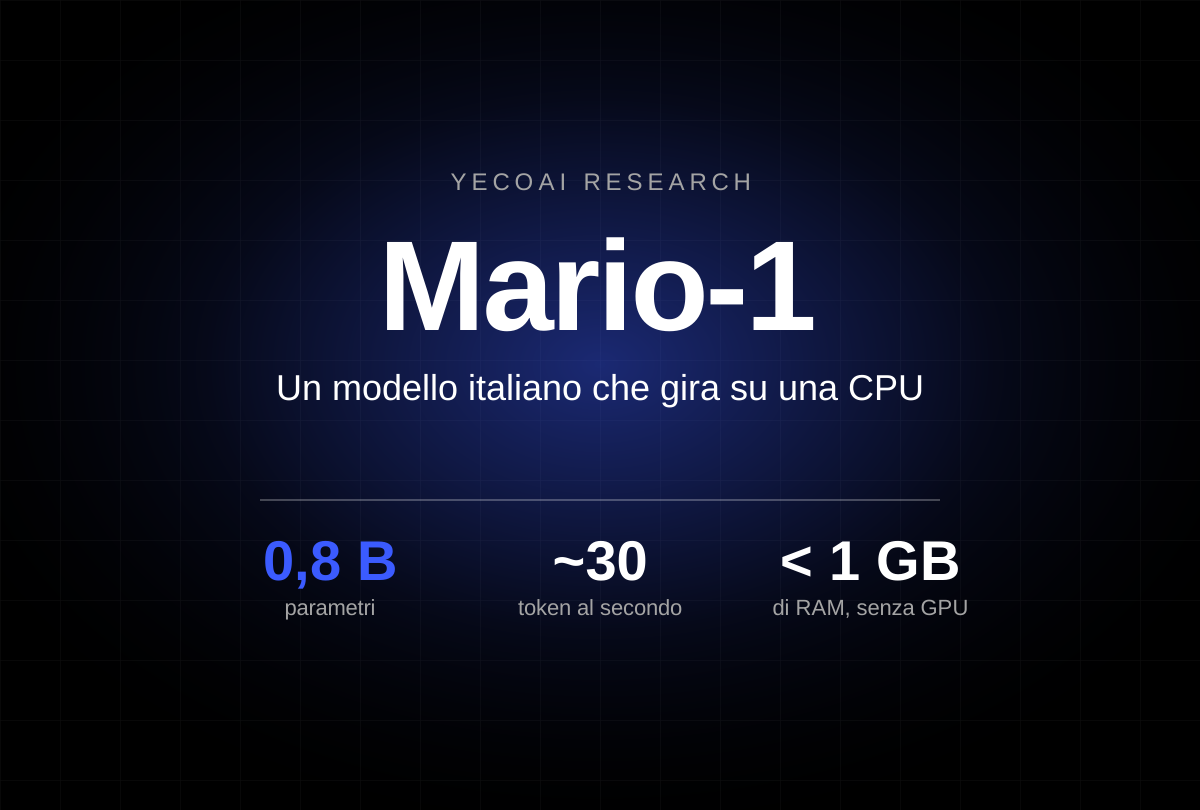
Mario-1: an Italian language model that runs on a CPU
A 0.8-billion-parameter language model built for Italian. It runs on a CPU without a GPU, recognises trick questions, admits what it does not know and does reliable arithmetic.
Research

Experimental AI models that speak Neapolitan and Piedmontese, released as open experiments. They are early versions and not part of our main product line.
Standard Italian is what textbooks teach; Italy speaks in regional varieties, from Neapolitan to Piedmontese and dozens more, that are not accents but linguistic systems with their own lexicon, morphology and syntax. For language technology this diversity is a blind spot: a model evaluated only on standard Italian silently fails the millions of speakers who write the way they talk. As our first experiments in this direction, we built two open dialect chat models, Napoletano-Ciro and Piemontese-Gioan. They are research artifacts, not products: early, experimental releases that may receive improved updates in the future.
The so-called Italian dialects are, in linguistic terms, Romance languages that evolved in parallel with Tuscan-Italian. Neapolitan and Piedmontese have deep literary traditions, and mutual intelligibility with standard Italian is partial at best. Treating these varieties as noise around a standard, misspellings, slang, accent, throws away structure a model could learn: systematic lexical substitutions, regular morphological differences and stable syntactic patterns.
Napoletano-Ciro and Piemontese-Gioan are LoRA adapters (PEFT, Parameter-Efficient Fine-Tuning) applied to Qwen/Qwen2.5-1.5B-Instruct, an open-weights third-party base model. The base model was not trained by us: our contribution is the adaptation. Each adapter was trained with Supervised Fine-Tuning on curated dialectal conversational pairs, using the AdamW optimizer with a linear schedule. Both are published on Hugging Face under the Apache 2.0 license, and a public demo, the ciro-gioan-chat Space, lets anyone talk to the two characters side by side.
Dialect lives in everyday conversation, so we chose a conversational format rather than a benchmark-first one: fixed characters give the models a consistent voice and make quality easy to judge by talking to them. The 1.5B base keeps the adapters cheap to train, run on CPU and share openly, which matters for low-resource varieties where the goal is coverage and community experimentation, not leaderboard scores.
These are early experiments. We plan to iterate: better curated corpora, more varieties, and stronger evaluation are the natural next steps, and future versions of the adapters may improve substantially.
Napoletano-Ciro and Piemontese-Gioan are not part of the Yeco LLM Series. The series is our family of proprietary, in-house models (Yeco-PII v1.0, Ender-1 and Yeco Flash Mini-IT v1), trained on our own pipelines. The dialect adapters are a separate research line: standalone experiments built on a third-party open-weights base, released under Apache 2.0 for anyone to inspect, run or extend.
With Napoletano-Ciro and Piemontese-Gioan we took a first, honest step into Italian dialect NLP: small, open, conversational experiments that put two regional languages into a chat window. Try them, break them, tell us where they fail: that feedback is exactly what the next iteration needs.
A 0.8-billion-parameter language model built for Italian. It runs on a CPU without a GPU, recognises trick questions, admits what it does not know and does reliable arithmetic.
Our new model that finds and hides personal data in text. More accurate than the previous version and better than much larger models, especially in Italian. Every release is digitally signed, so you can verify it is genuine.
118.1M-parameter Italian micro-LLM, trained for under €15, ~200 tok/s on CPU. Beats Minerva-350M (3× its size) on BoolQ-IT.